FETWATER PROGRAMME
Background
The Framework Programme for Research, Education & Training In The Water Sector (FETWater) was established in 2002, as a response to a 1998 study by the Department of Water and Sanitation, United Nations Educational, Scientific and Cultural Organisation (UNESCO) and the World Meteorological Organisation, which revealed a marked lack of human resources and competencies in the local water sector. This deficiency not only risks the implementation of the National Water Act, but also hampers the country’s ability to manage water in an integrated manner. This led to the establishment of FETWater Phase I (2002 to 2005) followed by FETWater Phase II (2007 to 2010). More than a thousand professionals received training through Phase I & II of the programme.
Phase I & II supported the following thematic areas:
• Resource directed measures
• Groundwater
• Beneficial use of water
• Wetlands and rivers
• Catchment management agencies expertise development
• Catchment management strategy development
• Water-related disaster management.
FETWater Phase III
The outcomes of the impact assessment report for FETWater Phases I and II (2010), and a meeting held between the Department of Water and Sanitation and UNESCO (2011) lead to Phase III of FETWater.
FETWater Phase III is a knowledge transfer and capacity building programme linking learning resources and training capacity to integrate water resource management expertise in areas where they are needed most. The programme utilised networks as mechanisms to ensure collaboration and to address specific capacity needs in the South African water sector.
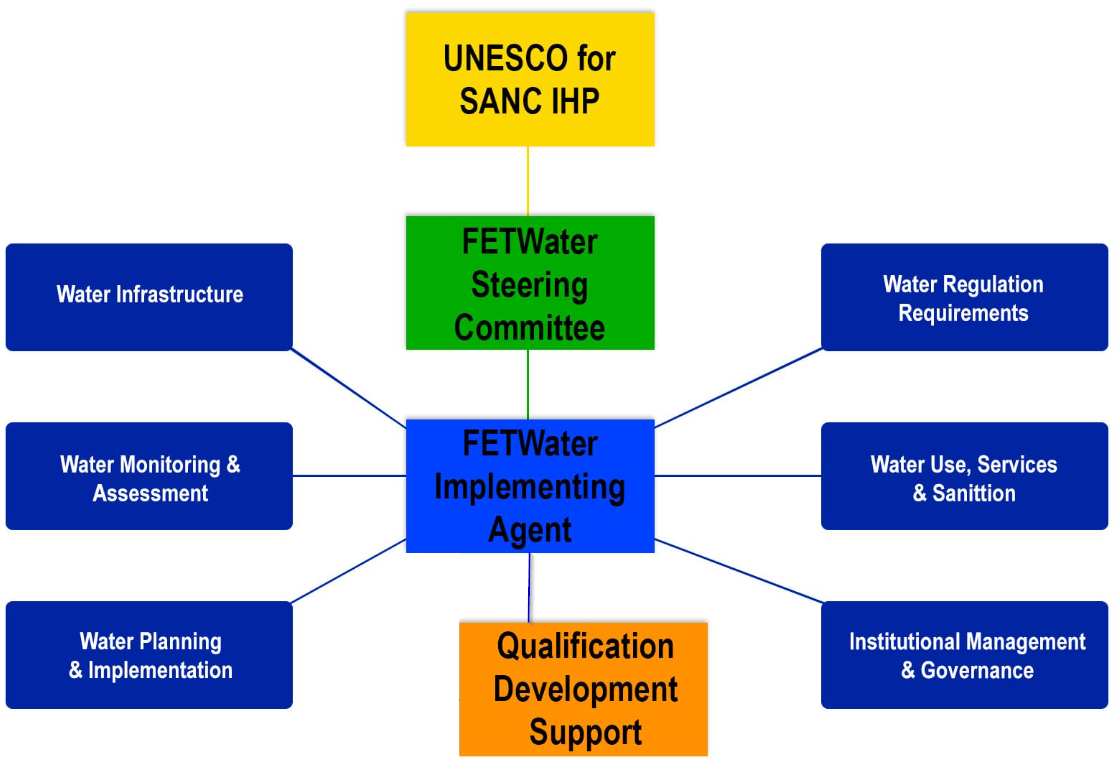
Phase III thematic areas:
• Water infrastructure
• Water monitoring and assessment
• Water planning and implementation
• Water regulation requirements
• Water use, services and sanitation
• Institutional management and governance
Capacity building needs and requirements considered in Phase III are:
• Advancement of technologies in the water space,
• Strengthening of the water regulatory system and development of regulatory tools,
• Local government capacity building using water as a catalyst for economic growth and development,
• Developing stronger inter-governmental relations and
• specialised skills and knowledge to manage water.
Governance of FETWater
In terms of governance, FETWater falls under the UNESCO Intergovernmental Hyrdological Programme (IHP). In South Africa, the Department of Water and Sanitation is the chair and focal point of UNESCO IHP. The UNESCO IHP activities in South Africa are carried out under the guidance of the South African National Committee (SANC) for UNESCO-IHP. The Intergovernmental Hydrological Programme (IHP) is one of the six international programmes (ISPs) of the United Nations system and the only programme devoted to water research, water resources management, and education and capacity building. Since its inception in 1975, IHP has evolved from an internationally coordinated hydrological research programme into an encompassing, holistic programme to facilitate education and capacity building and enhance water resources management and governance. UNESCO IHP has been the stimulus of strong interactions between scientific research applications and education. UNESCO IHP facilitates an interdisciplinary and integrated approach to watershed and aquifer management, which incorporates the social dimension of water resources, and promotes and develops international research in hydrological and freshwater sciences.